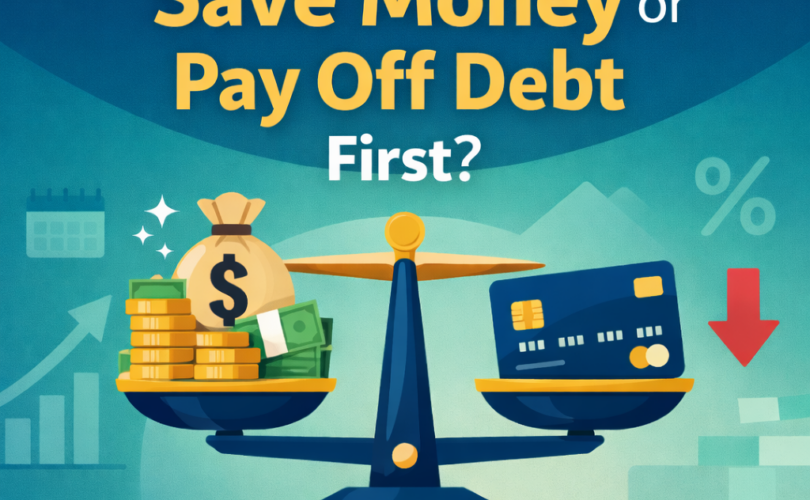
One of the most debated questions in personal finance is whether you should save money or pay off debt first. The right answer depends on your interest rates, financial stability, and long-term goals.
Why Paying Off Debt First Often Makes Sense
If you carry high-interest debt — especially credit card balances with rates near 25–30% — paying it off provides a guaranteed return equal to the interest rate you avoid.
For example, eliminating a credit card with a 25% APR is mathematically equivalent to earning 25% on an investment — without market risk.
High-interest debt compounds quickly and can significantly delay wealth building.
When Saving or Investing First Makes Sense
If your debt carries a low interest rate (such as 4–6% on some student loans or mortgages), investing may provide higher long-term returns.
Historically, broad market investments have returned around 8–10% annually over long periods, though returns are never guaranteed.
Starting early allows compound interest to work in your favor.
The Non-Negotiable: Build an Emergency Fund
Before aggressively investing or paying off debt, establish a small emergency fund. Even $1,000 to $3,000 can prevent you from going deeper into debt during unexpected events.
A Balanced Strategy
- Build a starter emergency fund
- Pay off high-interest debt aggressively
- Contribute enough to get employer retirement match
- Increase investing once toxic debt is eliminated
The Bottom Line
This is not an emotional decision — it’s a strategic one. High-interest debt drains wealth. Time builds wealth. The smartest move balances risk, return, and stability.
Choose the strategy that strengthens your net worth trajectory — not just the one that feels better in the moment.
Disclaimer
The content provided on MoneyMentor is for educational purposes only and does not constitute tax, legal, or investment advice. Financial decisions should be made with guidance from a qualified professional.